If you own a warehouse in Maspeth, a strip of storefronts in Jamaica, or a mixed-use building on Staten Island, your roof is one of the largest line items you will ever approve. Pick the wrong system and you pay twice: once for the install, and again for leaks, downtime, and an early replacement.
Most commercial owners in New York end up choosing between two paths. One is a low-slope “flat” roof built with a membrane such as TPO, EPDM, or modified bitumen. The other is a metal roof installation, usually standing seam panels. Both can be the right answer. The trick is knowing which one fits your building, your budget, and how long you plan to own the property.
This guide compares the two side by side, with real planning ranges, NYC rules that affect the decision, and the questions to ask before you sign anything.
Metal Roof vs. Flat Roof at a Glance
Here is the short version for busy owners and property managers.
| Factor | Flat (Low-Slope Membrane) Roof | Standing Seam Metal Roof |
| Typical NYC installed cost | About $7 to $14 per sq. ft. | About $13 to $25 per sq. ft. |
| Typical lifespan | About 15 to 30 years, depending on membrane | About 40 to 60+ years |
| Minimum slope | Designed for low slope (about 1/4 inch per foot for drainage) | 1/4 inch per foot for many standing seam systems; steeper for others |
| Install time (10,000 sq. ft.) | Often 1 to 2 weeks | Often 2 to 4 weeks |
| Rooftop HVAC and foot traffic | Easy to walk and service | Needs walkways and careful detailing |
| Solar mounting | Ballasted or attached racking | Clamps onto seams with no roof penetrations |
| Routine upkeep | Inspect seams, flashing, and drains twice a year | Inspect fasteners, seams, and sealants about once a year |
These are planning ranges for typical NYC commercial projects, not a quote. Tear-off, deck repair, insulation upgrades, crane access, and permits can move the number in either direction.
What Counts as a “Flat” Roof on a Commercial Building?
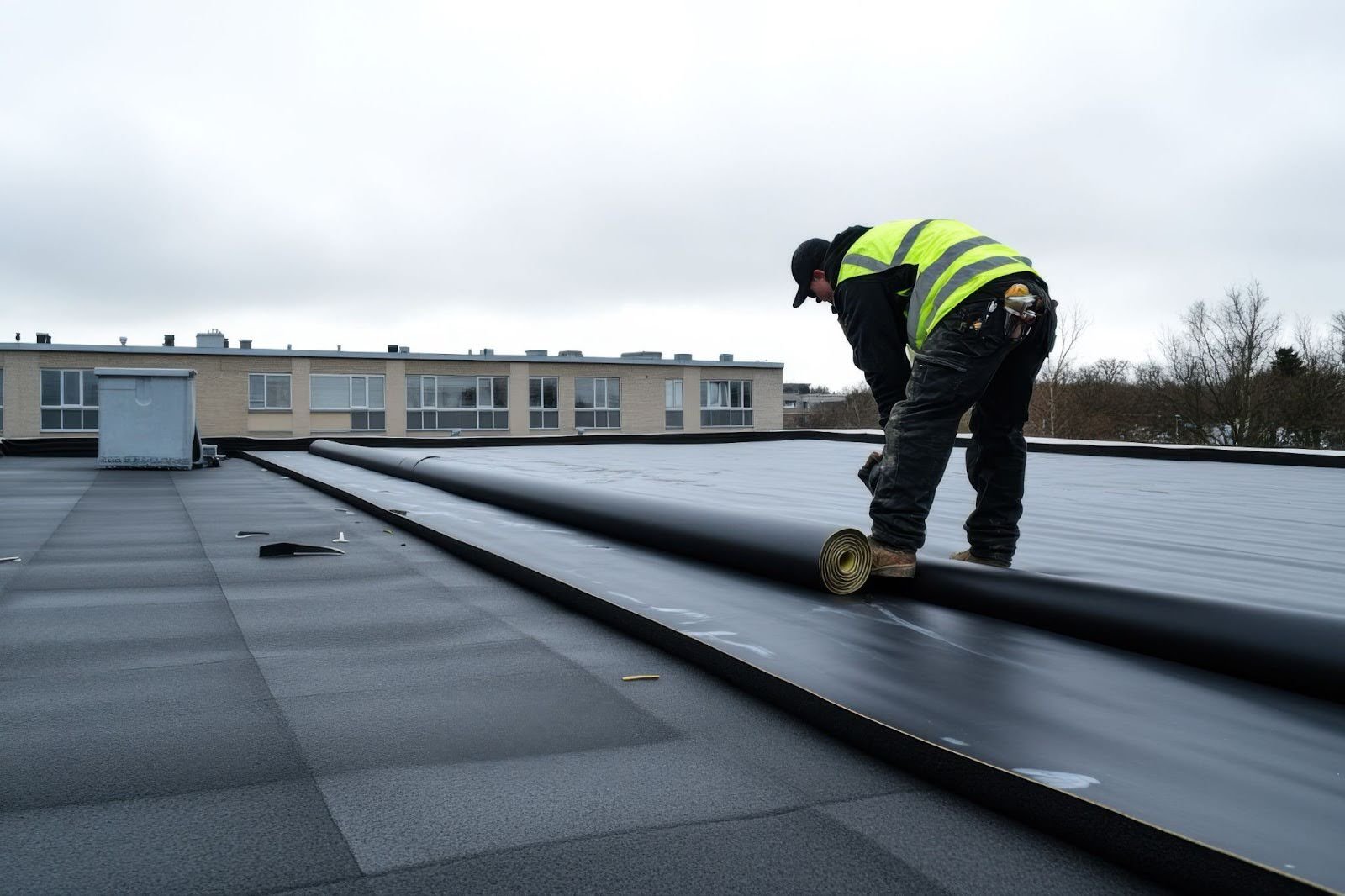
No commercial roof is truly flat. A “flat” roof is a low-slope roof, usually pitched about 1/4 inch per foot so water drains to scuppers, gutters, or interior drains. It is by far the most common roof on New York commercial buildings because it is affordable, easy to walk on, and works with rooftop equipment.
Common Flat Roof Membranes
- TPO (thermoplastic polyolefin): A white, heat-welded single-ply membrane. Reflective, budget friendly, and popular for cool roof compliance.
- EPDM (rubber): A durable synthetic rubber sheet that handles temperature swings well. Usually black unless a white version or coating is used.
- PVC: Similar to TPO but more resistant to grease and chemicals, which makes it a smart pick for restaurants.
- Modified bitumen: A multi-ply asphalt system that is common on NYC row buildings and mixed-use properties.
- Built-up roofing (BUR): Layers of asphalt and felt topped with gravel. Heavy and tough, but less common in new work today.
A well-installed membrane roof can last 20 years or more. The weak points are seams, flashings around equipment, and ponding water that sits for days after a storm.
What Is Involved in a Commercial Metal Roof Installation?
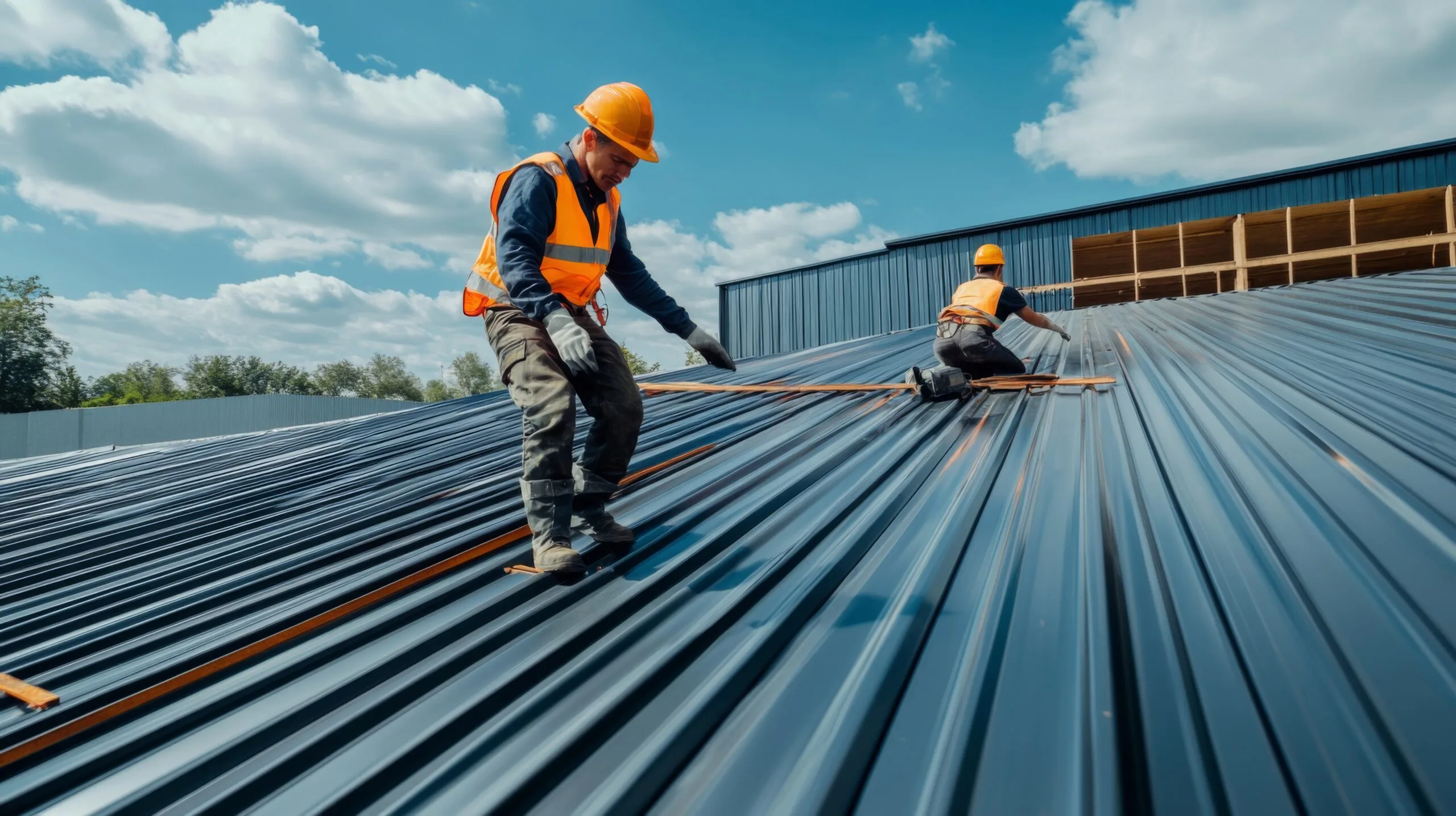
A commercial metal roof installation is a full system, not just panels. It typically includes the roof deck, insulation, underlayment, metal panels, clips that let the panels expand and contract, and trim at the edges, ridges, and penetrations.
Common Commercial Metal Roof Types
- Standing seam: Panels join at raised seams with hidden fasteners. This is the premium choice for long life and fewer leak points.
- Exposed fastener (R-panel or corrugated): Screws go through the panel face. It costs less up front but needs more fastener maintenance over time.
- Metal slate roof and shingle panels: Stamped steel or aluminum panels made to look like natural slate. A metal slate roof is a strong option for mansards, storefront canopies, and visible sloped sections where owners want the classic look without the weight or cost of real stone.
The Slope Question Most Owners Miss
Metal is not a drop-in swap for every flat roof. Under the International Building Code, which New York’s code is based on, standing seam metal roofs generally need a slope of at least 1/4 inch per foot, and many panel types need much more. If your roof has dead-flat spots or ponding areas, a metal roof installation may first require tapered insulation or framing to create slope. That can add real cost, so ask for it to be priced as its own line item.
Cost: Upfront Price vs. Total Cost of Ownership
Price is usually where the flat roof wins and where many owners stop reading. That is a mistake. The better question is how much the roof will cost per year of service.
Upfront Cost
On a typical NYC commercial job, a membrane roof often lands around $7 to $14 per square foot installed. A standing seam metal roof installation usually runs about $13 to $25 per square foot. On a 10,000 square foot building, that is roughly $70,000 to $140,000 for a membrane roof versus $130,000 to $250,000 for metal.
A Simple 30-Year Example
Here is an illustrative example for a 10,000 square foot building, using mid-range numbers:
| TPO Flat Roof | Standing Seam Metal | |
| Initial install | $100,000 | $190,000 |
| Expected service life | About 20 to 25 years | About 40 to 50+ years |
| Replacements in 30 years | Likely one | Likely none |
| Repairs and maintenance over 30 years (estimate) | $25,000 to $40,000 | $10,000 to $20,000 |
| Approximate 30-year total | $225,000 to $260,000 | $200,000 to $210,000 |
This example assumes one membrane replacement at a similar price and does not include inflation, energy savings, or financing. Your numbers will differ, but the pattern is common: metal costs more on day one and often less over a long hold.
If you plan to sell or redevelop within 10 years, a quality membrane roof usually makes more financial sense. If you plan to hold the building for 20 years or more, a metal roof installation deserves a serious look.
How Each Roof Handles New York Weather
New York roofs face freeze-thaw cycles, heavy rain, nor’easters, coastal wind, and the occasional snow load that sits for a week.
- Rain and ponding: Membranes tolerate low slopes but can fail where water ponds. Metal sheds water fast but cannot tolerate standing water at all.
- Snow: Metal sheds snow well, so plan snow guards above entrances, sidewalks, and parking. Flat roofs hold snow, which matters for older structures with limited load capacity.
- Wind: Both systems can meet wind uplift requirements when installed to the manufacturer’s tested assembly. Edge metal and perimeter fastening are where most wind failures start.
- Fire: Many metal and membrane assemblies can achieve a Class A fire rating. The rating applies to the tested assembly, so ask your contractor which listing your roof will meet.
NYC Rules That Can Change Your Decision
Commercial roofs in New York come with rules that many owners only learn about at permit time.
- Cool roof requirements: The NYC Energy Conservation Code generally requires reflective roofing when most of a low-slope roof is replaced or recovered. White TPO and coated systems meet this easily. Metal can as well, with the right reflective finish.
- Local Laws 92 and 94 of 2019: New buildings and certain major roof replacements must include solar panels, a green roof, or a combination on qualifying roof areas. Standing seam metal pairs well with solar because racking can clamp to the seams without drilling through the roof.
- Local Law 97: Larger buildings face carbon limits. A better insulated, reflective roof will not solve compliance alone, but it can help lower heating and cooling loads.
- Permits: Roof replacements that change structure, insulation, or the roof assembly may need a Department of Buildings filing. Your contractor should tell you exactly what applies and handle it.
Rules change, and each building is different, so confirm current requirements with your contractor and design professional before you commit to a system.
Metal Roof Repairs and Maintenance vs. Flat Roof Upkeep
No roof is maintenance-free. The difference is what you are maintaining and how often.
Flat Roof Maintenance
- Inspect twice a year and after major storms
- Keep drains, scuppers, and gutters clear
- Check seams and flashings around HVAC units, vents, and parapets
- Repair punctures from foot traffic and contractor work quickly
- Plan for recoating or patching around years 10 to 15 on many systems
Metal Roof Repairs and Maintenance
- Inspect at least once a year and after high winds
- Check exposed fasteners and replace worn washers (on R-panel roofs)
- Look for loose trim, failed sealant at penetrations, and scratched coatings
- Clear debris from valleys and gutters so water does not sit against panels
- Touch up scratches early to prevent rust on steel panels
Routine metal roof repairs and maintenance are usually small, targeted jobs. Most metal roof problems show up at penetrations, trim, and fasteners, not in the panels themselves.
Which Roof Fits Your Type of Building?
There is no single winner. Here is how we usually see the choice play out for commercial owners in Queens, Brooklyn, and Staten Island.
| Building Type | Usually the Better Fit | Why |
| Warehouse or industrial building with a sloped roof | Metal | Long life, low upkeep, solar ready |
| Retail strip or mixed-use with rooftop HVAC | Flat membrane | Easy access for service crews |
| Restaurant with kitchen exhaust | PVC flat roof | Resists grease and chemicals |
| Church, school, or building with visible sloped sections | Metal or metal slate roof | Curb appeal and longevity |
| Building you plan to sell within 10 years | Flat membrane | Lower upfront cost |
| Long-term hold of 20+ years | Metal (where slope allows) | Lower lifetime cost |
Many buildings use both: a membrane on the main low-slope area and metal on mansards, canopies, or sloped additions.
What to Ask a Roofing Contractor Before You Pay
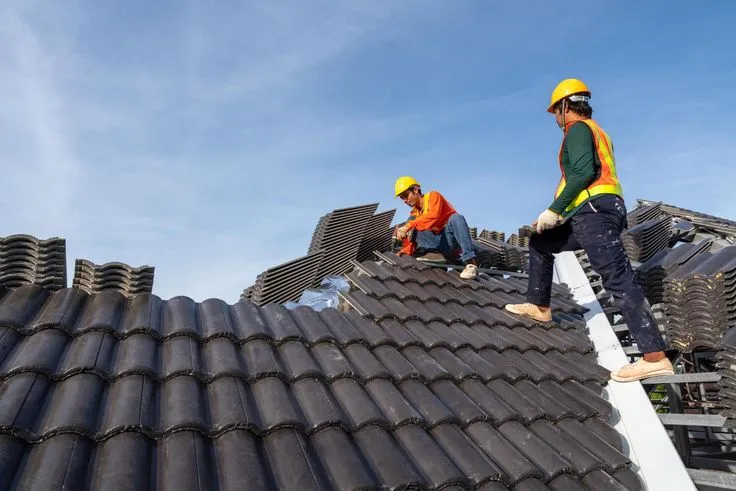
The contractor you hire matters as much as the material you pick. A great system installed poorly will leak. Knowing what to ask a roofing contractor protects your budget and your tenants.
- Are you licensed and insured in New York City? Ask for proof of general liability and workers’ compensation, and confirm your business is named as additional insured.
- Do you have commercial metal roof installation experience? Ask for addresses or photos of similar buildings you completed.
- Is my roof slope suitable for metal? If not, how will you build slope, and what does that cost?
- What is the full system? Get the panel or membrane brand, gauge or thickness, insulation R-value, underlayment, and attachment method in writing.
- What warranties come with it? Separate the manufacturer’s material warranty from your workmanship warranty, and ask whether a manufacturer system warranty is available.
- Who pulls permits and handles NYC compliance? Cool roof, solar or green roof rules, and DOB filings should be addressed in the proposal.
- How will you keep my business running? Ask about phasing, noise, dumpster placement, sidewalk protection, and daily dry-in.
- How are deck repairs priced? Get a per-square-foot rate in the contract so hidden damage does not become a blank check.
- What does the maintenance plan look like? A good contractor will offer inspections after the job is done.
If a bid is far below the others, compare these answers line by line. Low prices often leave out insulation, deck repair, or flashing work.
Metal Roofing in Queens, NY: Local Considerations
If you are looking for metal roofing in Queens, NY, local conditions matter. Many Queens commercial buildings are older masonry structures with parapet walls, multiple past roof layers, and tight access from busy streets. That affects tear-off cost, staging, and whether a metal roof installation is practical without structural changes.
Benny’s Contracting offers Roof Contracting Services in Queens, NY for both membrane and metal systems. We start with a roof survey, core cuts where needed, and a clear look at your drainage and structure, so you know which option fits before you spend a dollar on materials.
For larger projects, our Commercial Roof Installation team handles full replacements, recovers, and new construction across New York City, with phasing plans built around your tenants and business hours.
Frequently Asked Questions
Can you install a metal roof on a flat commercial roof?
Sometimes. Standing seam systems can work on slopes as low as about 1/4 inch per foot, but truly flat or ponding areas need tapered insulation or framing first. A contractor should confirm your slope before recommending a metal roof installation.
How long does a commercial metal roof last?
A properly installed standing seam metal roof often lasts 40 to 60 years or more, with basic maintenance. Exposed fastener panels may need fastener replacement within 15 to 20 years.
Is a metal roof installation worth the extra cost?
For owners who plan to hold a building for 20 years or longer, it often is, because you may avoid a full replacement during that time. For shorter holds, a quality membrane roof is usually the better value.
What is a metal slate roof?
It is a metal roofing panel stamped to look like natural slate. It gives the traditional look at a fraction of the weight and is common on mansards, canopies, and churches.
Are metal roofs noisy in the rain?
On a commercial building with insulation and a solid deck, rain noise is rarely an issue. Noise is more noticeable on open-framed structures without insulation.
How often do flat roofs need repairs?
Most flat roofs need minor repairs every few years, mainly at seams and flashings. Twice-yearly inspections catch small problems before they reach the interior.
Get a Clear Answer Before You Pay for a New Roof
Choosing between a flat roof and a metal roof installation comes down to your slope, your building’s use, NYC compliance, and how long you plan to own the property. The right contractor will walk you through all four, in writing, before asking for a deposit.
As a trusted Roofing Contracting Company Staten Island business owners call for commercial and residential work, Benny’s Contracting LLC serves property owners across Staten Island, Queens, and Brooklyn. We will inspect your roof, compare both options side by side with real numbers, and give you a detailed proposal with no pressure.